Silt fence, inlet protection, construction exits, BMP maintenance after rain, and slope and creek bank stabilization for builders, site contractors and property owners in Athens-Clarke County.
Most of Athens sits on Piedmont soils with a red clay subsoil. Once a bulldozer strips the topsoil off a lot, that clay sheds water fast and carries fine sediment with it. Every heavy storm then tests the silt fence, the inlet protection and the construction exit on every open job in Athens-Clarke County.
That sediment does not stay on the lot. It moves down curb lines and storm drains into Trail Creek, Sandy Creek, McNutt Creek and the North and Middle Oconee Rivers. Keeping it on site is the whole point of erosion control, and it is exactly what county inspectors look for after rain.
We handle the work that keeps a site compliant from first clearing to final stabilization: installing perimeter controls, maintaining them after storms, and getting permanent cover established so the site can close out.
What we install and maintain
Erosion Control Services in Athens, GA
Each service matches a specific problem on a specific kind of site. Tell us what you're seeing and we'll tell you which one fits.
Builders · Site contractors
Silt Fence Installation & Repair
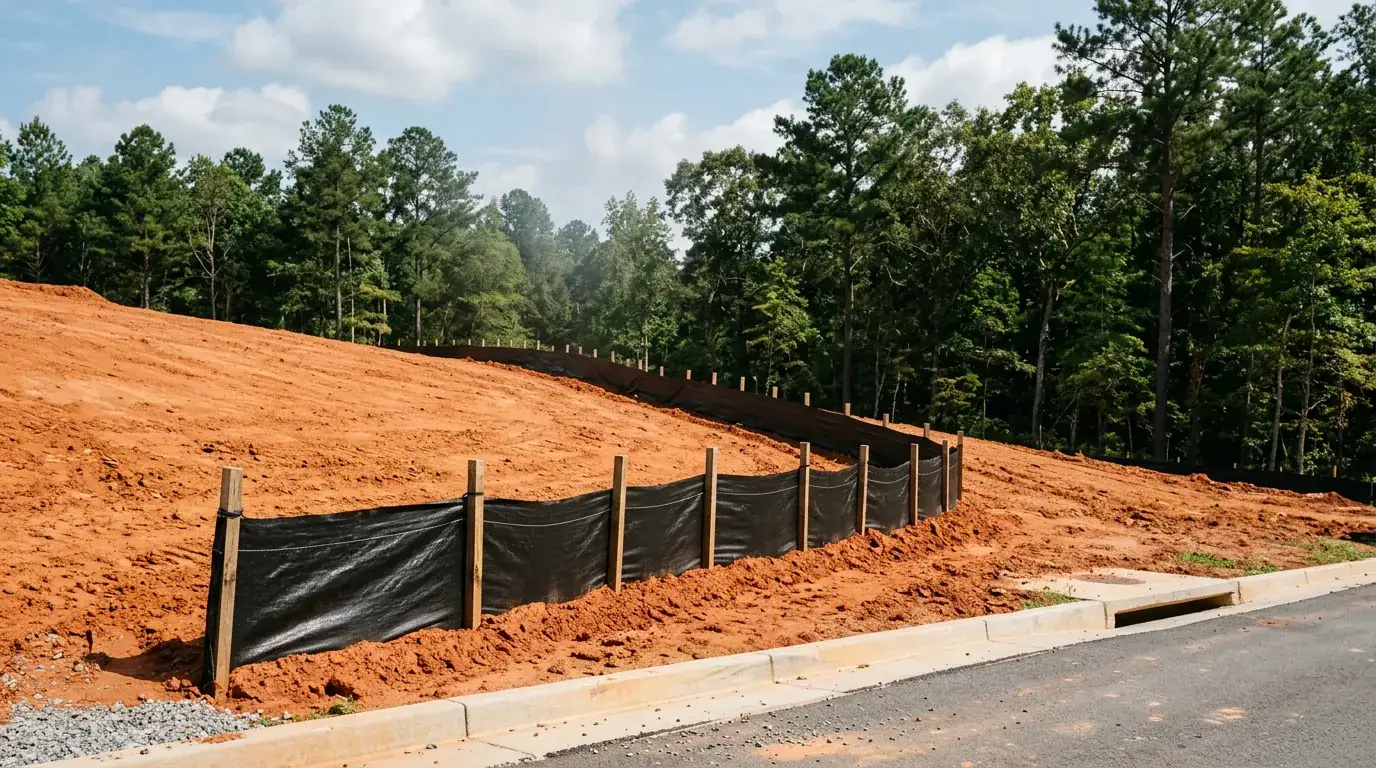
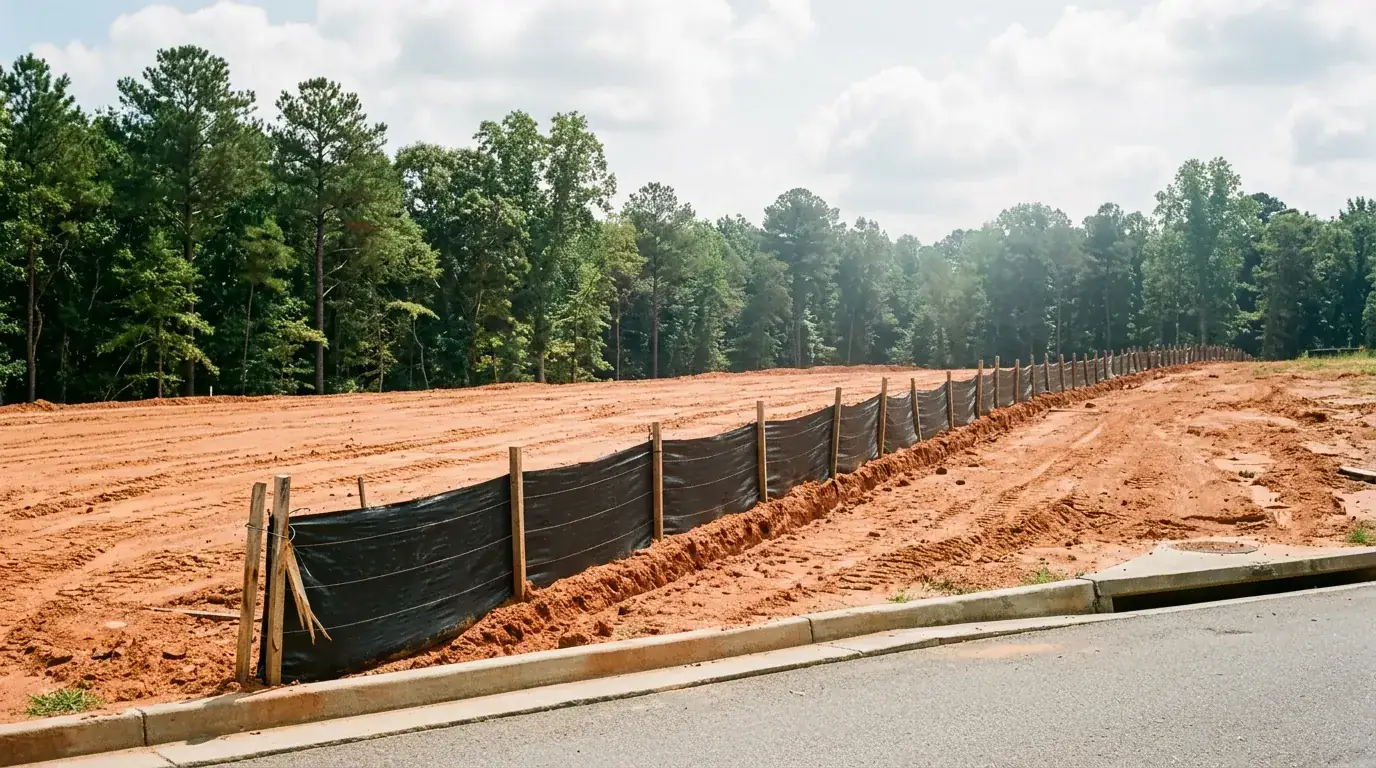
Trenched-in silt fence along the downhill perimeter, sized to the drainage area behind it. We use reinforced fence where the plan calls for it, and we repair undercut, overtopped or knocked-down runs after storms.
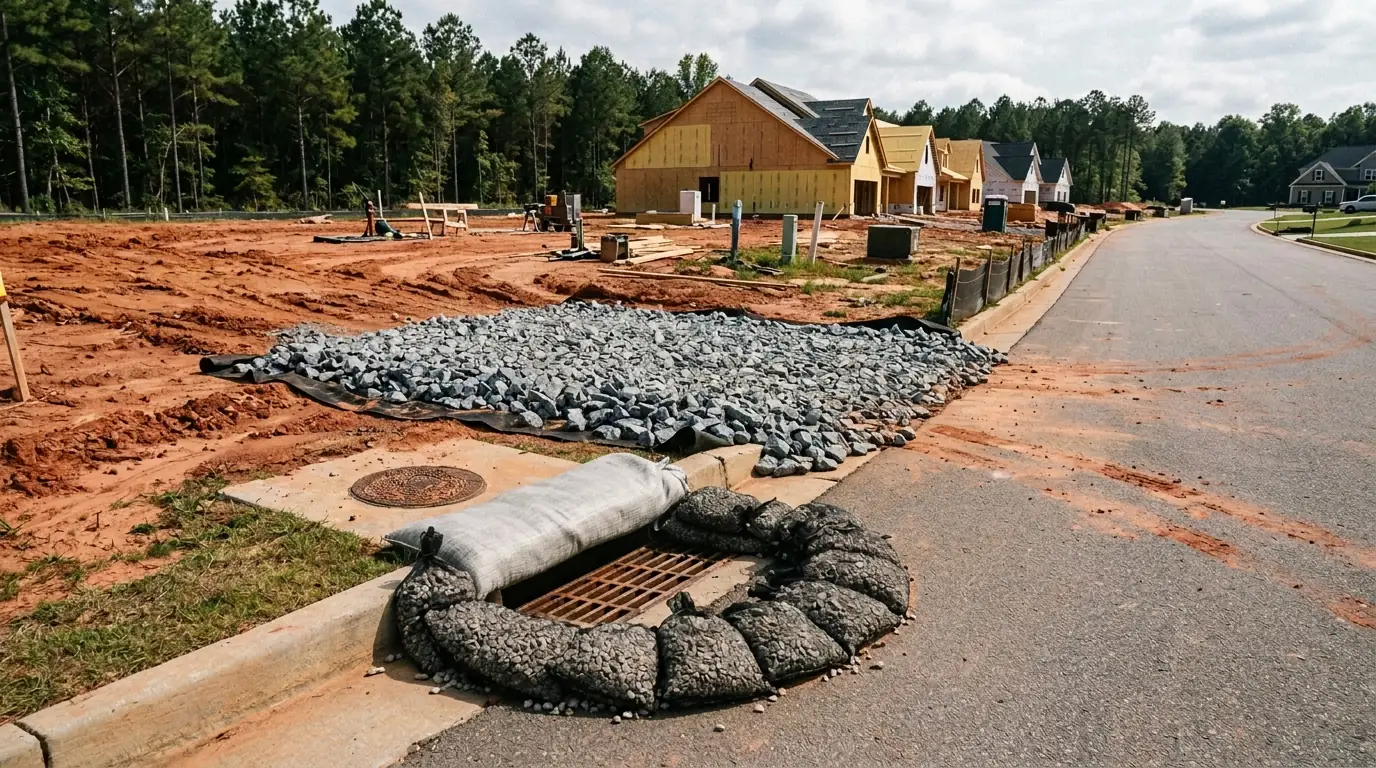
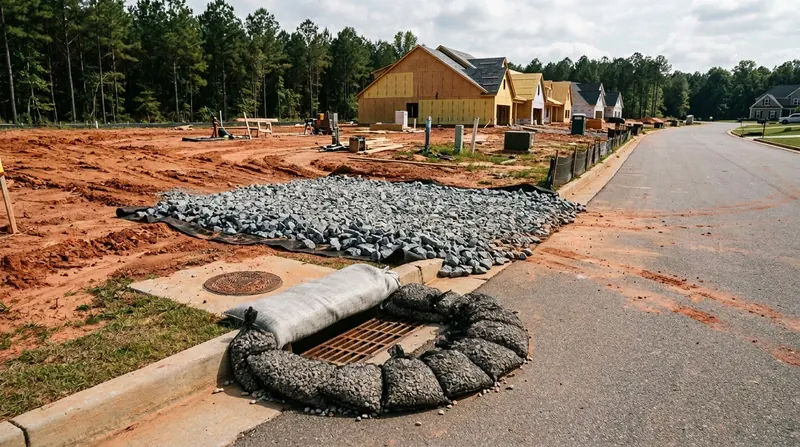
Inlet sediment filters on curb and drop inlets, plus stone construction exits that knock mud off tires before trucks hit an Athens street. These two controls are usually the first thing an inspector sees from the road.
Scheduled and after-rain maintenance: cleaning out sediment behind fence and check dams, rebuilding exits, replacing clogged inlet filters, and reseeding bare areas before they become a finding.
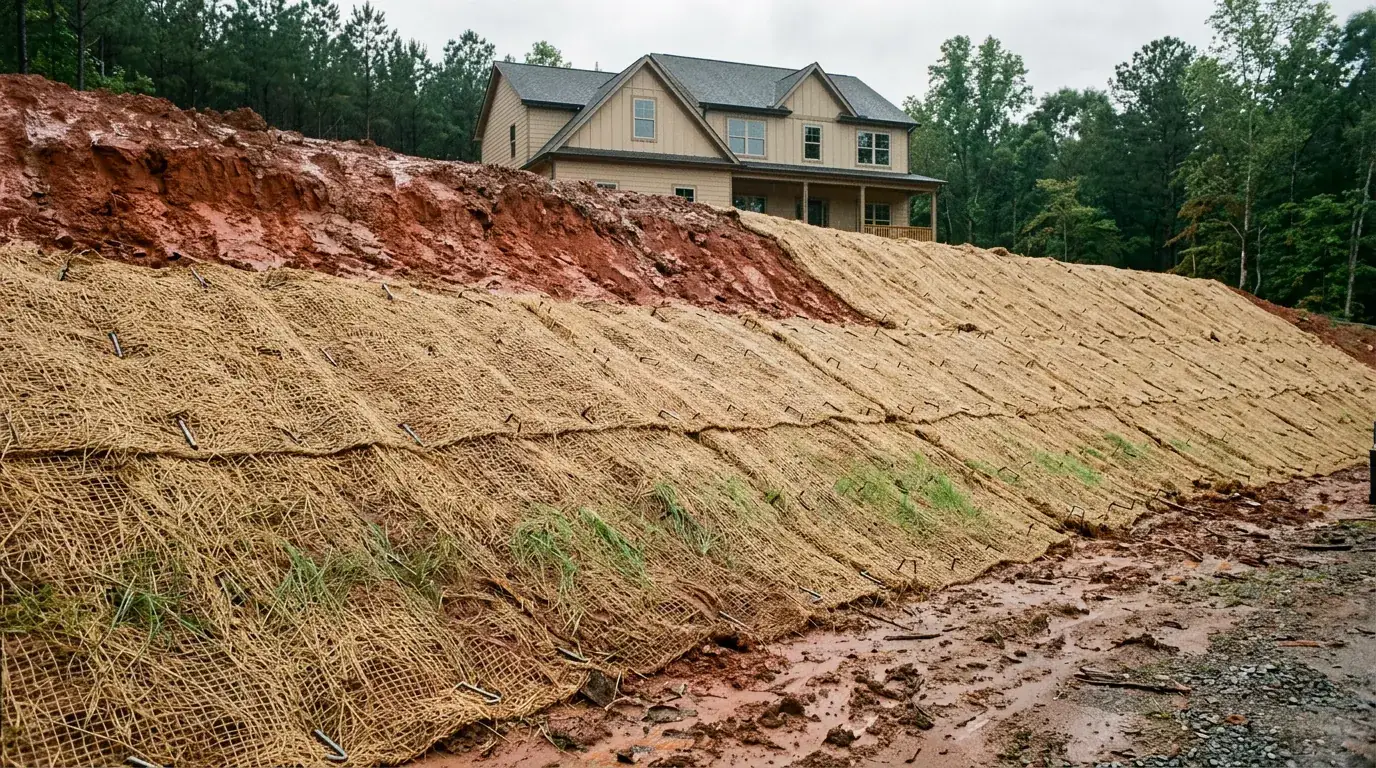
Erosion control blankets, turf reinforcement mats, wattles and hydraulic mulch with tackifier or bonded fiber matrix for cut banks, fill slopes and backyard hills that keep washing out.
Coir logs, matting, riprap and vegetation for eroding stream banks, plus check dams and lining for ditches and swales that scour after every storm. Work near streams is planned around state and county buffers.
Temporary seeding to hold idle graded areas, then permanent cover to close out a site. Seed mix and mulch type follow the season and slope. The same work fixes bare, washing new-build yards.
Perimeter silt fence: trenched in and staked so sheet flow off the graded lot is filtered before it reaches the street.Stone construction exit and curb inlet protection: the two controls an inspector sees first from the road.
Start with where the water goes
Every control decision begins with the drainage path. Sheet flow across a gentle lot edge is a silt fence job. Concentrated flow down a swale will undercut silt fence in one storm, so it needs check dams, a sediment trap or a lined channel. Water headed for a storm inlet needs inlet protection, and anything headed for a creek needs extra margin.
Match the control to the slope
On flatter areas, straw mulch or standard hydromulch over seed works. On steeper cut and fill slopes, loose mulch slides, so bonded fiber matrix or a rolled erosion control blanket does the job. Where water runs across the slope face, a turf reinforcement mat or riprap may be needed.
Plan for Athens clay
Red clay subsoil crusts and sheds water, which is why bare graded areas here erode fast and grass struggles without soil preparation. Loosening the surface, testing pH, adding lime and fertilizer, and covering seed right away make the difference between cover that holds and a second trip.
Maintain after every real rain
BMPs don't fail on sunny days. Sediment fills in behind fence, inlet filters clog, and exit stone gets buried in mud. Checking and fixing controls after significant rain is what keeps a site out of trouble between inspections.
Getting to closeout: temporary BMPs come out only after disturbed areas have permanent cover. Seeding late or in the wrong season is one of the most common reasons sites sit open longer than planned.
Who We Work With in Athens
Builders & Developers
Subdivision phases and in-town infill. You need controls in before clearing, kept up through vertical construction, and taken down only once lots are stabilized. Your concerns are inspections, schedule and closeout.
Grading, utility and commercial pad work. You need a sub who installs to the plan detail, shows up after storms, and keeps the BMP side off your superintendent's plate.
A backyard slope that won't hold grass, a creek eating into the yard, mud running onto a neighbor's lot after an addition. You want it fixed once, at a fair price.
Athens job sites vary a lot from block to block: historic in-town lots near the North Oconee, subdivision phases on the Eastside, commercial pads out Atlanta Highway, and rural tracts in north Clarke County. Pick an area to see the work that typically comes up there.
Erosion Control on the Eastside & Lexington Road Corridor
30605 · Subdivision phases · Production and local builders
The Eastside has active new-home phases, including new construction off Old Lexington Road and the final phase of Ashton Place near the UGA Veterinary School. Multi-lot work like this usually falls under Georgia EPD's common-development construction permit (GAR100003), which means BMPs have to hold up across many lots selling and building at different speeds.
The trouble spots are predictable. Construction exits get buried when ten trades come and go each day. Curb inlets downhill of open lots load up after every storm. Silt fence on lots between closings gets driven over and never reset. We set exits sized for the traffic, protect each inlet in the phase, and put a fast temporary cover on idle lots so bare dirt isn't sitting there for weeks.
Final Stabilization on the Westside, Jennings Mill & Atlanta Highway
30606 · Commercial pads and new neighborhoods · GCs and developers
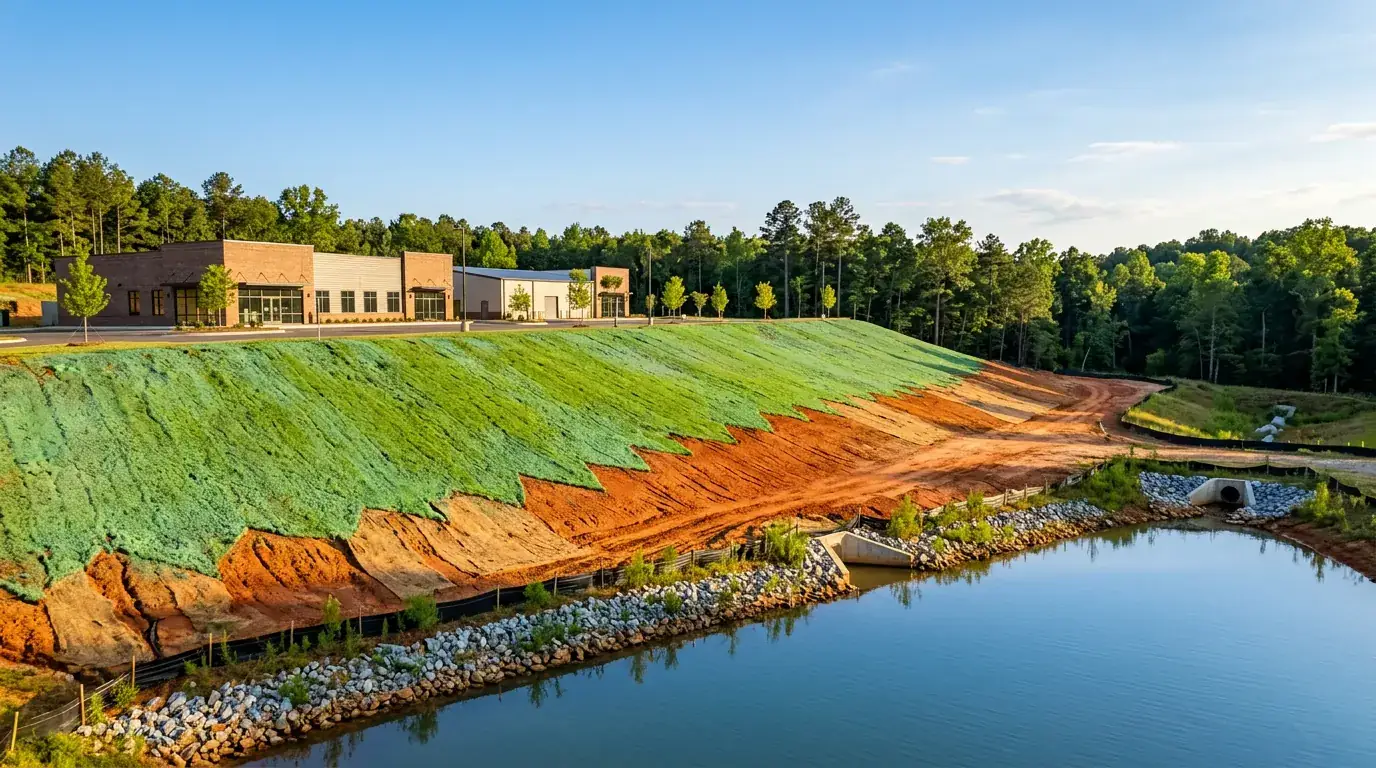
Hydromulch on a pad slope above a detention pond: permanent cover is what lets temporary BMPs come down.
West Athens mixes commercial pads along the Atlanta Highway side with newer neighborhoods off Jennings Mill Road. On these jobs the expensive problem usually comes at the end: the building is done, but bare slopes, detention pond banks and parking-lot islands still lack permanent cover. The site can't close out, and temporary BMPs have to stay up and maintained.
For pad slopes and pond banks we use hydraulic mulch with tackifier or bonded fiber matrix, and blankets where water runs down the face. The goal is cover that actually establishes, so the Notice of Termination isn't waiting on grass.
In-Town Infill East of Downtown, Near the North Oconee River
30601 · One-acre infill lots · Small builders
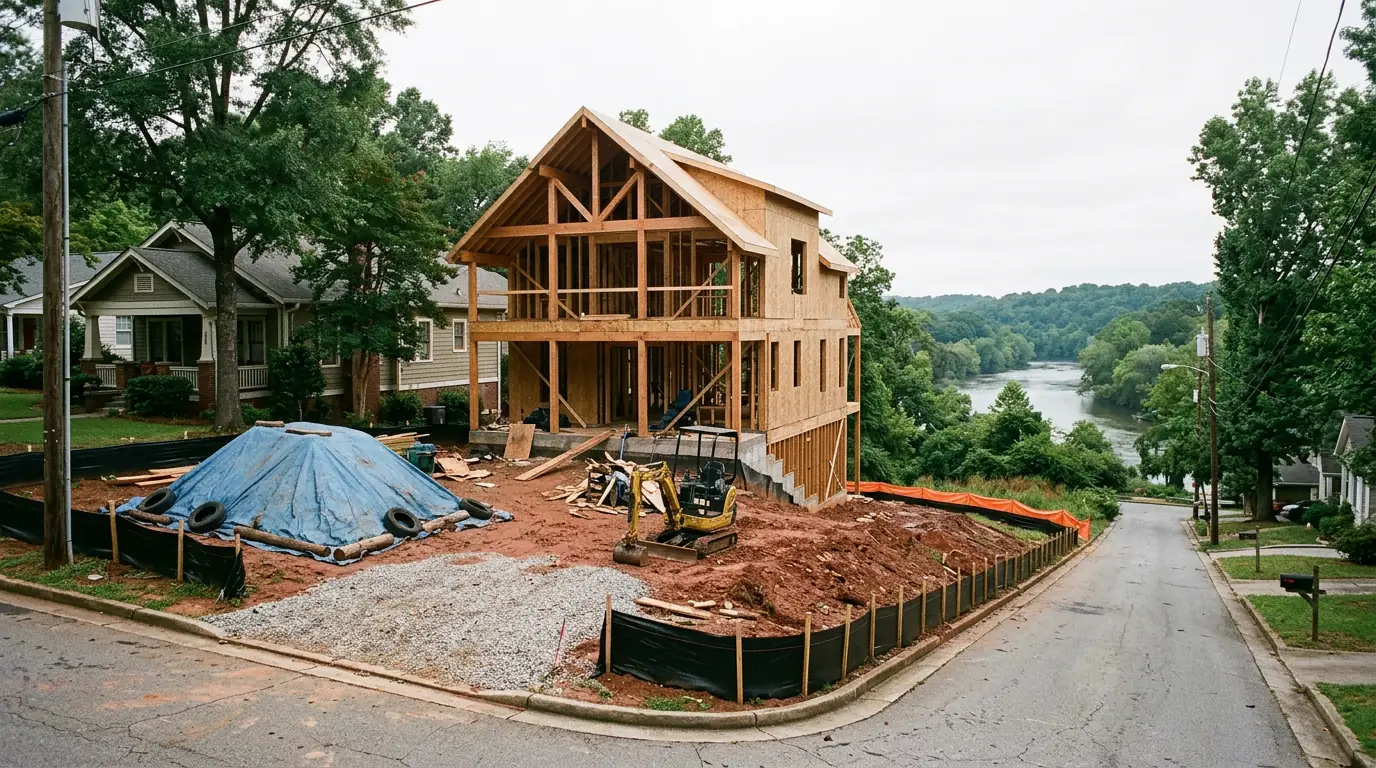
Tight in-town infill: perimeter silt fence, a covered stockpile and buffer fencing on the side that drains toward the river.
Infill east of downtown, including new homes on larger lots along North Peter Street and Poplar Street, sits close to the North Oconee River and its greenway. In Athens-Clarke County, work within 200 feet of state waters requires an approved soil erosion and sedimentation control plan, and the county's stream buffer runs 75 feet from the top of bank on most perennial streams.
On short, steep in-town lots the margin for error is small. A single failed run of fence puts clay in the street and the storm drain, and neighbors notice. We focus on tight perimeter control, protecting the buffer edge, and getting slopes covered quickly. Keeping stockpiles off the downhill side matters here too.
East Athens / Chicopee-Dudley · Homeowners and small builders
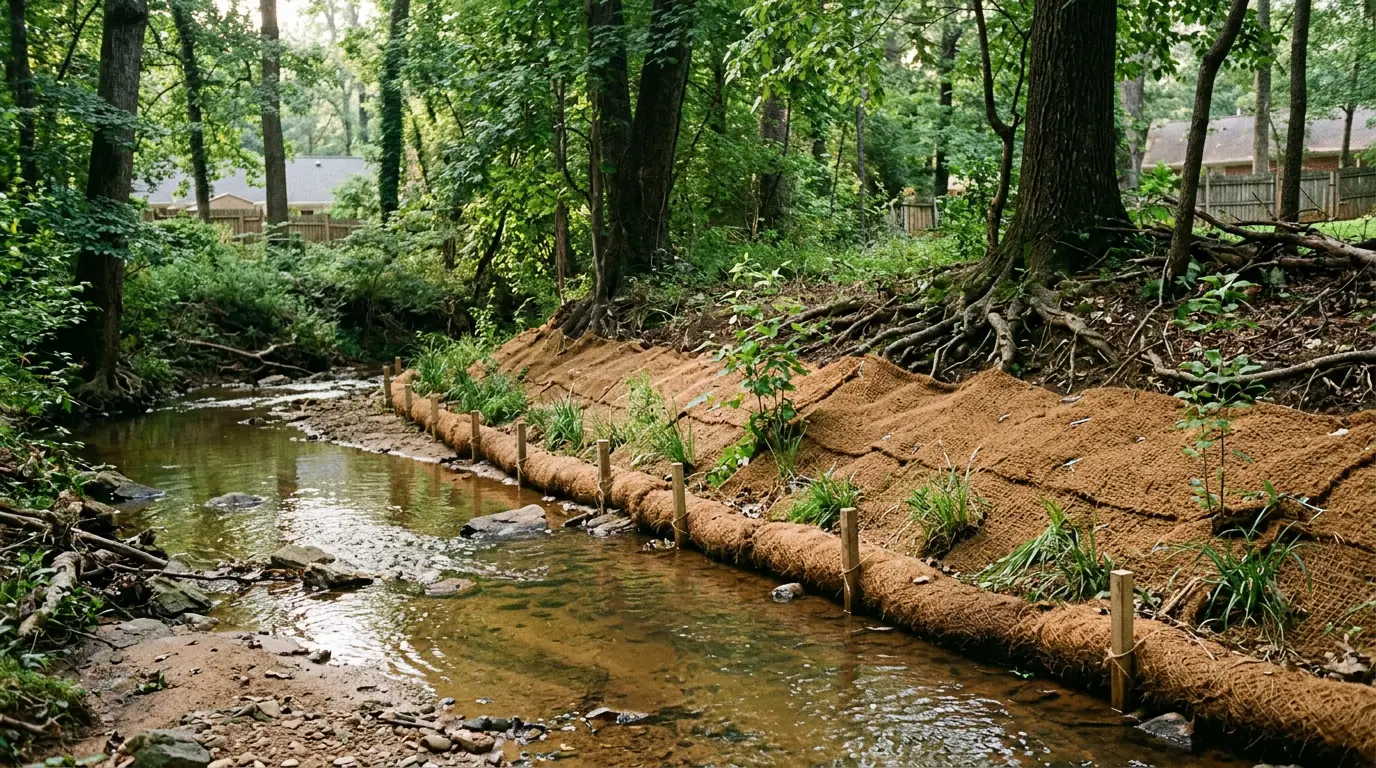
Coir log at the toe and coir matting up the bank: a soft fix that works within stream buffer limits.
Trail Creek forms where its East and West Forks meet in north Clarke County. It passes under Loop 10, Vine Street and East Broad Street before joining the North Oconee at Dudley Park. Properties along its branches can see undercut banks, falling trees and yard loss after big storms.
Bank work comes with rules. The state buffer is 25 feet, the county's is generally 75 feet, and anything in the channel itself may need Army Corps review. That usually points to softer fixes like coir logs, matting and native plantings rather than heavy equipment. We start by checking what's allowed with ACC Stormwater Management, then design around it.
30606 / 30605 · Older homes, additions and pools · Homeowners and remodelers
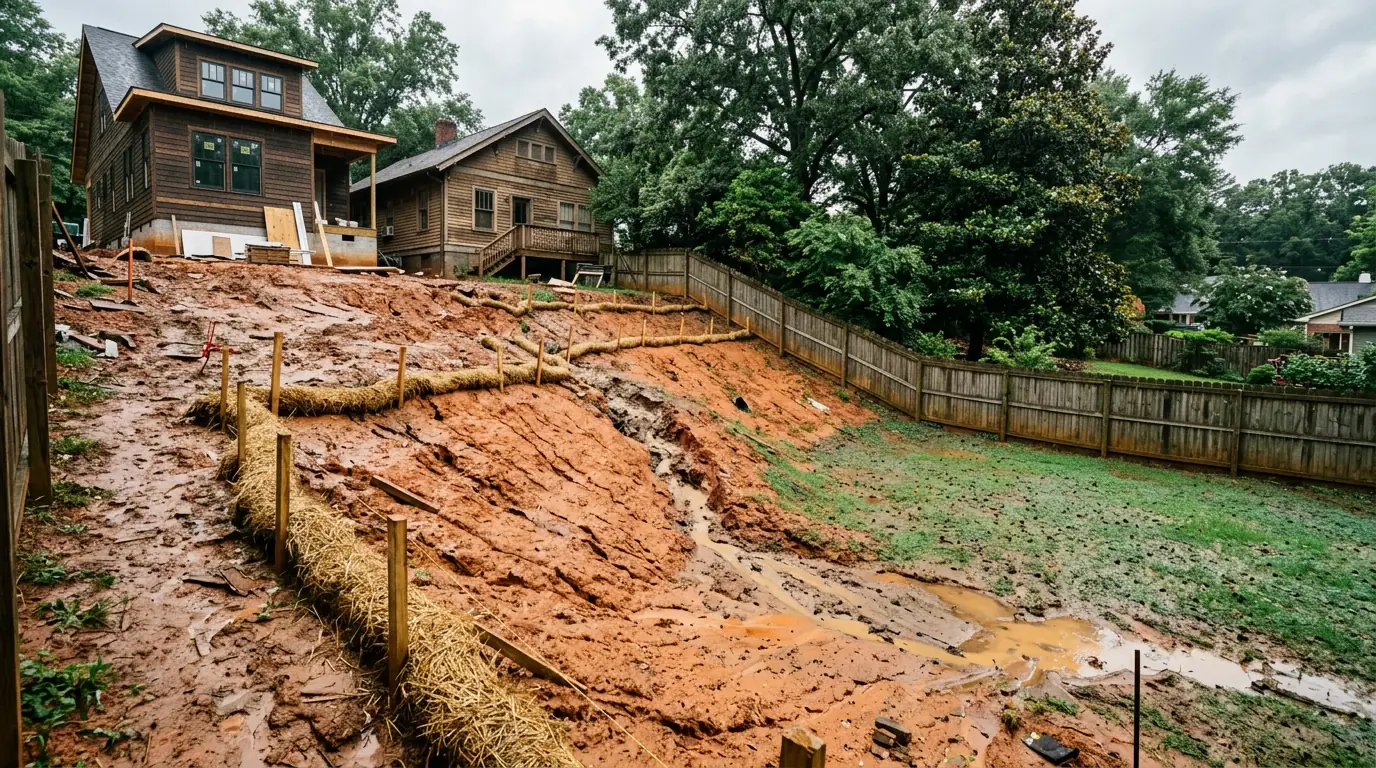
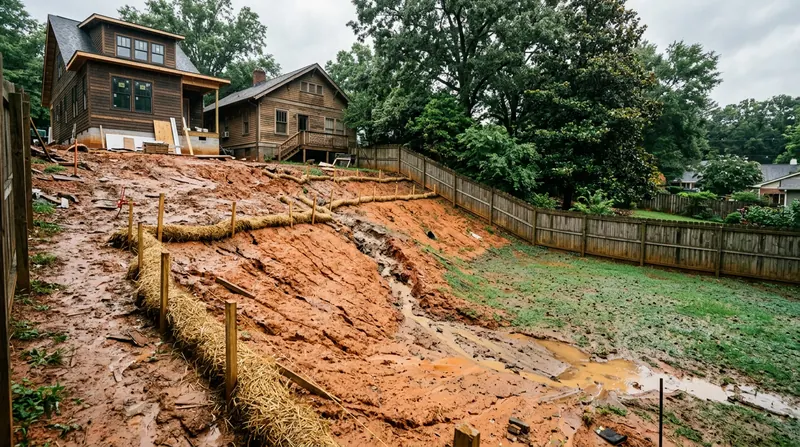
Renovation washout: one storm on a bare clay yard cuts a channel straight toward the neighbor's fence, even with wattles in place.
Five Points is an established 1920s-era neighborhood around Milledge Avenue, Lumpkin Street and Milledge Circle. Work there tends to be renovation: additions, pools and regrading, often on yards that drain toward a neighbor downhill. Once a mature lawn is torn up, the clay underneath washes hard in the first storm.
Typical fixes are wattles across the slope during work, then seed protected by blanket or bonded fiber matrix on the steep parts and hydroseed on the flatter yard. Homeowners usually care about two things: keeping mud off the neighbor's property, and grass that comes back without washing out twice.
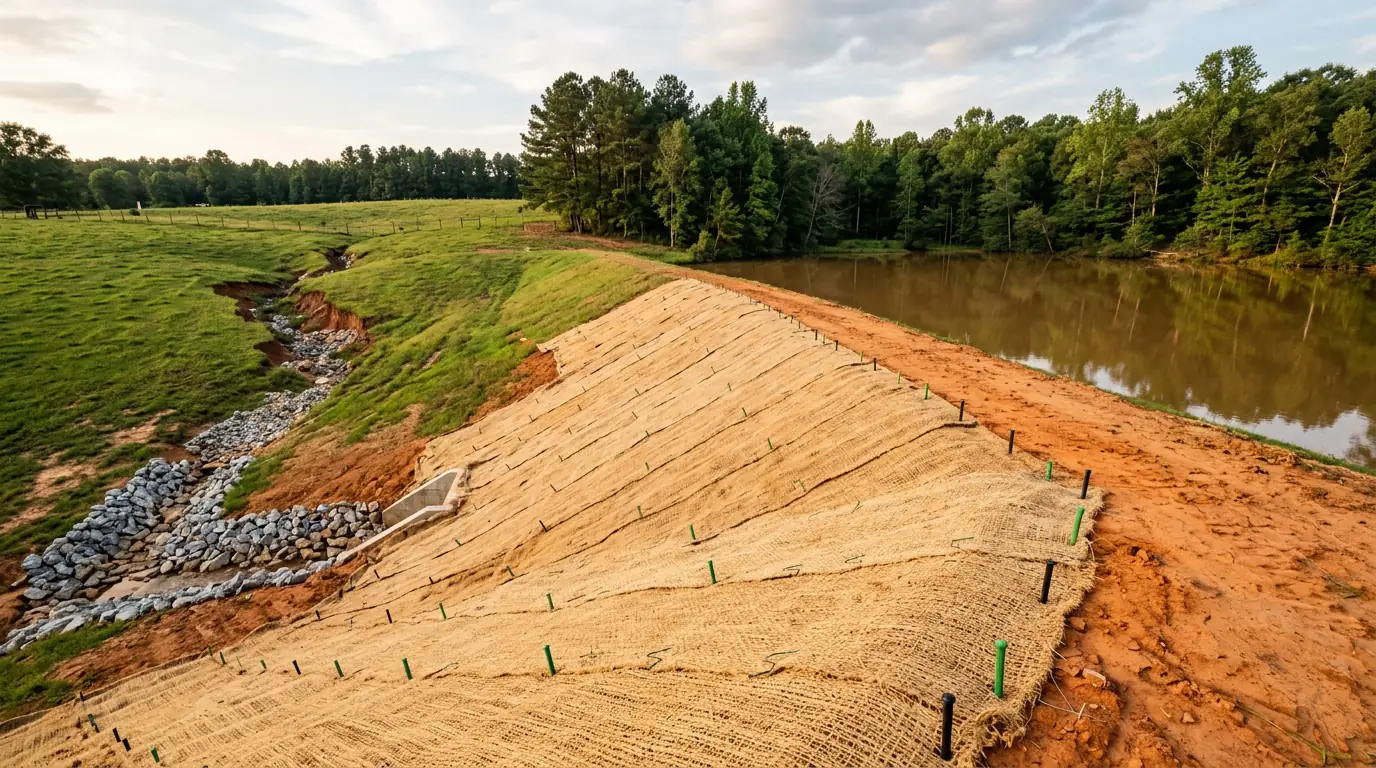
Pond dam repair: blanket over the regraded dam face and riprap in the gully where runoff concentrates.
North Clarke County has larger tracts, ponds, and land draining toward Sandy Creek and Lake Chapman. The problems here are slower but bigger: gullies that grow a little every storm, eroding pond dam faces, and spillways cutting back toward the dam.
Repairs usually combine regrading, riprap where water concentrates, and blanket plus seed on the dam face. A dam with seepage, a sinkhole or a slumping face needs an engineer before any cosmetic fix. We'll tell you if that's what we see.
Tight historic lots off Prince Avenue leave little room for stockpiles or a full-size construction exit. Narrow streets show tracked mud immediately. Short exits, inlet protection on the nearest curb drains, and covered stockpiles are the usual package.
McNutt Creek & the West Line
Utility and road work along the west side of the county runs long and linear, which is the territory of the infrastructure permit (GAR100002). Ditch lining, check dams and daily cover on open trench spoil keep sediment out of McNutt Creek and the Middle Oconee.
Pulaski Heights
On historic lots near downtown where a bare yard slopes toward the street, rills can form after one storm. On grades like that, blankets pinned over seed outlast loose straw.
Beechwood & Homewood Hills
Mature lots with natural drainage swales scour when upstream lots get developed. Rock check dams and a lined swale bottom stop the down-cutting without re-piping the yard.
Whitehall & Barnett Shoals Road
Lots that sit graded but idle between phases are classic temporary-seeding jobs. A fast cover crop plus mulch keeps them from shedding clay into perimeter fence for months.
Timothy Road
Newer homes here often come with thin, patchy new-build yards that wash every storm. Soil prep and hydroseeding in the right season fixes the cause instead of reseeding the symptom.
Winterville
Gravel driveways and long road frontage in this small city east of Athens lose their edges to runoff. Stabilized shoulders, riprap aprons at culverts and seeded swales hold them. Winterville handles its own permits.
Bogart
Projects near the Oconee County line can fall under a different permitting office than Athens-Clarke. Confirm the issuing authority first. The BMPs themselves follow the same Georgia Green Book.
Erosion Control by Athens ZIP Code
Erosion Control in 30601
Downtown and the in-town ring east toward the North Oconee River. Expect infill lots, tight access, and the 200-foot state-waters rule coming into play. Perimeter control and fast cover on short slopes are the priority.
Erosion Control in 30605
The Eastside, stretching toward the Oconee County line, where much of the subdivision phase work is. Construction exits, phase-wide inlet protection and lot-by-lot stabilization make up most of the work.
Erosion Control in 30606
West and southwest Athens, from Five Points out toward Jennings Mill and the Atlanta Highway side. It mixes renovation slopes in older neighborhoods with commercial and new-neighborhood stabilization and closeout.
Erosion Control in 30607
North Athens and north Clarke County around Sandy Creek. Larger tracts mean gully repair, pond dam faces, long driveways and drainage ditches more than lot-line silt fence.
Soil, Slopes & Weather in Athens
Athens sits in the Georgia Piedmont, where the dominant upland soils are Cecil-type: a thin sandy or loamy topsoil over thick red kaolinitic clay. Where topsoil has already eroded or been graded off, that red clay is the surface. It crusts, sheds water and resists seed.
The terrain is rolling, with short steep drops toward creeks and the two Oconee forks. Rain comes year-round, with hard summer thunderstorms and longer winter soaking rains, so controls need to work in every season.
Soil varies parcel to parcel. The USDA NRCS Web Soil Survey shows mapped soils for any address, and a soil test through UGA Extension tells you what lime and fertilizer a site needs.
Seeding windows in the Athens area
Fall: the main window for permanent tall fescue.
Late spring–summer: bermudagrass for sunny permanent cover; millet as summer temporary cover.
Fall–winter: cereal rye as quick temporary cover on idle graded areas.
Exact dates, seed rates and mulch rates for permitted sites come from the disturbed-area stabilization tables in the Manual for Erosion and Sediment Control in Georgia and your approved plan.
Warning Signs Your Site Is Losing Soil
Small rills or deeper gullies cutting down a bare slope
Silt fence bulging, undercut at the bottom, or buried past halfway
Red mud on the street, the curb line or the construction exit
Clogged or bypassed inlet filters
Cloudy, orange-brown water leaving the site or entering a creek
Slumping or undercut creek banks; trees leaning toward the water
Seeded areas with bare washout channels after rain
One of these doesn't automatically mean starting over. Often it's one failed run of fence or one missing check dam.
After a big storm, the first priority is safety. Stay off saturated slopes and creek banks, keep away from fast-moving water in ditches, and call the utility before going near any exposed line.
Next comes damage control: reset or replace failed fence, clean out sediment, rebuild the construction exit, and get bare washouts reseeded and covered before the next rain. On permitted sites, document what failed and what was repaired.
This is a general overview, not legal advice. Your engineer's plan and the issuing office govern your specific site.
Local: Athens-Clarke County
Athens-Clarke County is the Local Issuing Authority under its Soil Erosion, Sedimentation and Pollution Control Ordinance (Code Chapter 8-3). Land disturbance permits run through Transportation and Public Works. The Planning Department reviews work near environmental areas, including anything within 200 feet of state waters.
State: Georgia EPD & GSWCC
Disturbances of one acre or more, or smaller lots in a larger common plan, generally need coverage under Georgia EPD's NPDES construction stormwater permits, filed through GEOS. Practices must meet the Georgia Soil and Water Conservation Commission's Green Book. GSWCC is headquartered on Lexington Road in Athens, and its Urban Lands Erosion & Sediment Control program handles state technical guidance and certification questions.
Buffers
State law protects a 25-foot buffer along state waters. Athens-Clarke County generally requires 75 feet from the top of bank on most perennial streams, with limits on equipment and tree removal. ACC Stormwater Management makes stream determinations.
Certified personnel
Georgia requires people involved in land-disturbing activity to hold GSWCC education and training certification. On permitted sites, a Level IA certified person must be on site while land disturbance is happening.
What Happens When You Call
Request a quote. Call or send the form with the address, site type and what you're seeing.
Site evaluation. We look at slope, soil, drainage paths, access, nearby creeks and what your plan requires.
Recommendation & price. You get specific controls, quantities and a written price.
Install. Fence, exits, inlet protection, blankets or seeding go in to the plan detail.
Follow-up. After-rain maintenance on active sites, and establishment checks on seeded areas.
What Affects Erosion Control Cost in Athens?
Two sites with the same acreage can price very differently. These are the factors that actually drive the number:
Linear feet of silt fence, and whether the plan calls for standard or reinforced
Number of inlets to protect and construction exits to build
Slope steepness and whether water runs across it
Soil condition and how much prep the clay needs before seeding
Mulch method: straw, hydromulch, bonded fiber matrix or blanket
Access, mobilization and phasing
How often BMPs need maintenance and how much rain the season brings
Get an actual price, not a guess
Send the address and a few photos, or your plan sheet if you have one, and we'll come back with quantities and a written price.
Example jobs that show how we approach common Athens situations: the problem, the fix and what it should accomplish. Every site is quoted after we see it.
Example job · Eastside, 30605
New Subdivision Phase
The situation
A builder has 12 open lots across a new phase. Construction exits are buried in mud, and curb inlets fill up after every storm.
The work
Construction exits sized for the trade traffic, a filter at each curb inlet in the phase, silt fence reset on lots between closings, and temporary seed and mulch on idle lots.
The result
Streets and inlets stay clean between inspections, and lots are ready for final stabilization as they sell.
Fence trenched and staked the way the Green Book shows it, not just stretched along the ground.
Back after the rain
Maintenance happens when it matters, which is right after a storm, not on a calendar that ignores the weather.
Built for closeout
Seeding and mulch are chosen to establish permanent cover, so temporary BMPs can come down and the site can close.
Athens, GA Erosion Control FAQs
How much does erosion control cost in Athens, GA?
Price depends on linear feet of silt fence, the number of inlets and construction exits, slope, soil condition, access, how often BMPs need maintenance, and the seed and mulch method. An on-site look is the only way to give an accurate number.
Do I need a permit to grade or disturb land in Athens-Clarke County?
Athens-Clarke County is the Local Issuing Authority for land disturbance under its Chapter 8-3 ordinance. Disturbances of one acre or more generally also need coverage under Georgia EPD's NPDES construction stormwater permits, and work within 200 feet of state waters requires an approved erosion and sedimentation control plan. Requirements vary by project, so confirm with ACC Planning and Transportation and Public Works before you start.
What are the stream buffer rules in Athens-Clarke County?
Georgia requires a 25-foot buffer on state waters, and Athens-Clarke County requires a 75-foot buffer from the top of bank on most perennial streams, with limits on mechanized equipment and tree removal. ACC Stormwater Management handles stream determinations.
Why does silt fence fail?
The most common causes are fence that was never trenched in, sediment piled past about half the fence height, water concentrated at one low point, and fence used across a channel where a check dam or sediment trap belongs.
How soon after a storm should BMPs be inspected?
Your permit and plan set the inspection schedule. In practice, silt fence, inlet protection and construction exits should be checked after every significant rain, because that is when sediment loads and failures show up.
Can grass grow on Athens red clay?
Yes, with preparation. Much of the Athens area sits on Cecil-type soils with a red kaolinitic clay subsoil. Loosening the surface, liming and fertilizing based on a soil test, seeding in the right season and protecting seed with mulch, hydromulch or a blanket all improve establishment.
Hydroseeding vs. straw and seed: which is better on a slope?
On steeper slopes, a hydraulically applied mulch with tackifier, or a bonded fiber matrix, holds seed in place better than loose straw. On the steepest or most concentrated-flow areas, an erosion control blanket or turf reinforcement mat is usually the better choice.
When is the best time to seed in Athens, GA?
Fall is the main window for tall fescue in the Georgia Piedmont, while bermudagrass is seeded in warm weather. Bare construction areas can be covered year-round with a temporary crop, such as cereal rye in cool months or millet in summer, following the seeding tables in the Georgia Green Book.
What does final stabilization mean for closing out a site?
Final stabilization generally means disturbed areas have permanent cover, usually established vegetation, so temporary BMPs can be removed and the permit closed. The exact standard comes from your permit and approved plan.
Do you work with homeowners or only builders?
Both. Builders and site contractors call for silt fence, inlet protection, exits and maintenance. Homeowners call about washed-out slopes, creek banks, bare yards and mud running onto a neighbor's property.
Do you serve 30605, 30606, 30601 and 30607?
Yes. Those are the main Athens ZIP codes, and each has different typical work: in-town infill in 30601, subdivision phases in 30605, commercial and new neighborhoods in 30606, and larger rural tracts in 30607.
Will hydroseed wash away in a heavy rain?
Fresh hydroseed can wash out in a hard storm before it germinates, especially on steep ground or where water concentrates. Tackifier, a heavier mulch rate, bonded fiber matrix or a blanket on flow paths lowers that risk, and washouts should be reseeded quickly.
Who do I call about sediment in the street from a nearby job site?
If it is your site, fix the construction exit and inlet protection first. If it is someone else's, Athens-Clarke County handles erosion and sediment complaints under its Chapter 8-3 ordinance.
Need Erosion Control in Athens, GA?
Tell us where the site is and what you're seeing: a failing fence, mud in the street, a slope that won't hold, or a site that needs to close out. We'll come back with a plan and a price.